Gertrude the Great
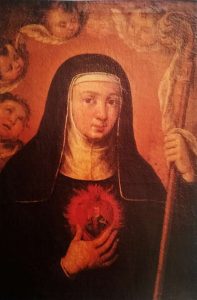 Gertrude the Great, or Saint Gertrude of Helfta (6th January [the Feast of the Epiphany] 1256 – 17th November 1302) was a German Benedictine nun and mystic from the monastery of Helfta. Gertrude produced numerous writings, though only some survive today. The longest that survives is the Legatus Memorialis Abundantiae Divinae Pietatis (known in English today as The Herald of Divine Love or The Herald of God’s Loving-Kindness), which was partly written by other nuns.
Little is known of the early life of Gertrude who was born in Eisleben, Thuringia (within the Holy Roman Empire). At the age of four, she entered the monastery school at St. Mary at Helfta under the direction of its abbess, Gertrude of Hackeborn. It is speculated that her devout parents offered her as a child oblate to the church. However, given that Gertrude implies in the Herald that her parents were long dead at the time of writing,[4] it is also possible that she entered the monastery school as an orphan.
Gertrude was entrusted to the care of Mechtilde, younger sister of the Abbess Gertrude, and joined the monastic community in 1266. It is clear from her own writings that she received a thorough education in a range of subjects. She, and the nun who authored Books 1 and 3 – 5 of the Herald, are thoroughly familiar with scripture, the Church Fathers such as Augustine of Hippo and Gregory the Great, and also more contemporary spiritual writers such as Richard and Hugh of St. Victor, William of St Thierry, and Bernard of Clairvaux. Moreover, Gertrude’s writing demonstrates that she was well-versed in rhetoric, and her Latin is very fluent.
n 1281, at the age of 25, she experienced the first of a series of visions that continued for the rest of her days, and which changed the course of her life.
Gertrude reported a vision on the Feast of John the Evangelist. She was resting her head near the wound in the Christ’s side and hearing the beating of his heart. She asked John if on the night of the Last Supper he had felt these pulsations, why he had never spoken of the fact.
John replied that this revelation had been reserved for subsequent ages when the world, having grown cold, would have need of it to rekindle its love.
Her priorities shifted away from secular knowledge and toward the study of scripture and theology. Gertrude devoted herself strongly to personal prayer and meditation, and began writing spiritual treatises for the benefit of her fellow nuns.
Gertrude became one of the great mystics of the 13th century. Together with her friend and teacher Mechtilde, she practiced a spirituality called “nuptial mysticism,” that is, she came to see herself as the Bride of Christ.
Gertrude died at Helfta, near Eisleben, Saxony, around 1302. Her feast day is celebrated on 16th November but the exact date of her death is unknown; the November date stems from a confusion with Abbess Gertrude of Hackeborn.
Collect for Gertrude the Great
Almighty God, who inflamed the heart of Saint Gertrude the Great with love for you, grant that through her intercession, our own hearts may be kindled with the fire of your divine love.
May we, like her, seek your presence with all our being and experience the joy of your indwelling grace.
Through Jesus Christ our Lord. Amen.
With thanks to Wikipedia and Google Gemini
Gertrude of Nivelles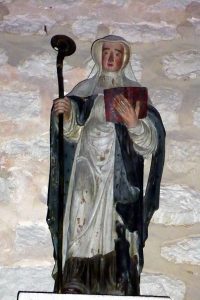
Gertrude of Nivelles (c 628 – 17th March 659) was a seventh-century abbess who, with her mother Itta, founded the Abbey of Nivelles, now in Belgium.
The early history of Gertrude’s family is not well documented. The anonymous author of her Early Middle Ages biography, Vita Sanctae Geretrudis, only hints at her origins: “it would be tedious to insert in this account in what line of earthly origin she was descended. For who living in Europe does not know the loftiness, the names, and the localities of her lineage?”
Gertrude’s father, Pepin of Landen (Pippin the Elder), had managed to have his son Dagobert I crowned King of Austrasia.
When the court moved to Neustria, Pippin and his family (including young Gertrude) moved with it. Thus, Gertrude became introduced to politics during her childhood in the royal court.
Gertrude’s biography begins with her father hosting a banquet when Gertrude was ten years old. At this feast, the King asked Gertrude if she would like to marry the “son of a duke of the Austrasians… for the sake of his worldly ambition and mutual alliance.”
Gertrude declined and “lost her temper and flatly rejected him with an oath, saying that she would have neither him nor any earthly spouse but Christ the Lord.”
The mention of Gertrude’s decided rejection of her Austrasian suitor is unique for the era and may have been deliberately included by the chronicler as expressing her character. The reference to a prior betrothal to Christ becomes common in later saints’ lives.
After Dagobert’s death, Pippin returned to the east in 640, taking Gertrude with him. Soon after, Pippin himself died, giving Gertrude the freedom to take the veil and enter the monastic life.
Gertrude’s mother Itta, in order to prevent “violent abductors from tearing her daughter away by force,” shaved her daughter’s hair, leaving only a crown shape. This action, known as tonsuring, marked Gertrude for a life of religious service.
Upon Itta’s death at about the age of 60 in the year 652 Gertrude took over the monastery. At this time, Gertrude took the “whole burden of governing upon herself alone,” placing affairs of the family in the hand of “good and faithful administrators from the brothers.”
Gertrude had “temperance of character” and was “an intelligent young woman, scholarly and charitable, devoting herself to the sick, elderly, and poor,” and knowing much of the scripture as she could by memory. Gertrude also memorised passages and books on divine law, and she “openly disclosed the hidden mysteries of allegory to her listeners.” Her Vita describes Gertrude as building churches, and taking care of orphans, widows, captives, and pilgrims.
Upon becoming abbess, Gertrude “obtained through her envoys men of good reputation, relics of saints and holy books from Rome, and from regions across the sea, experienced men for the teaching of the divine law and to practice the chants for herself and her people.”
She welcomed foreigners, lay or religious. She especially welcomed Irish monks who, since the sixth century, travelled to evangelise.
The first miracle attributed to Gertrude in the Vita takes place at the altar of Pope Sixtus II the Martyr as Gertrude was standing in prayer. “She saw descending above her a flaming pellucid sphere such that the whole basilica was illuminated by its brightness.” The vision persisted for about half an hour and later was revealed to some of the sisters at the monastery. The anonymous author of the Vita believes that this vision represents a “visitation of the True Light.”
Gertrude is portrayed as leading a devout life until her death. It is possible that after taking the veil in ca. 640, she never left the monastery cloister, thus escaping politics and local affairs. Gertrude is described as “exhausted by a life of charity, fasting and prayer” at the end of her short life.
The Cambridge Medieval History says that “because of too much abstinence and keeping of vigils… her body was sorrily exhausted with serious illness.”
Gertrude’s Vita describes her, after relinquishing her role as abbess, spending her time praying intensely and secretly wearing a hair shirt. According to her biographer, Gertrude felt the time of her death approaching and asked a pilgrim from the Fosses monastery when she would die. The pilgrim prophesied that Gertrude would die on 17th March, the very next day, and also the feast day of Saint Patrick. Furthermore, he prophesied that “she may pass joyously because blessed Bishop Patrick with the chosen angels of God… are prepared to receive her.” True to the prophecy, Gertrude died the next day after praying all night and taking communion.
Shortly after her death, the monk Rinchinus as well as the author of the Vita noticed a pleasant odour in the cell with her body.
Just before her death in 659, Gertrude instructed the nuns at Nivelles to bury her in an old veil left behind by a travelling pilgrim and Gertrude’s own hair shirt.
Collect for Gertrude of Nivelles
Almighty God, gracious friend of all creatures, we thank you for Saint Gertrude of Nivelles, whose hospitality embraced both travellers and the souls in purgatory.
Grant that we, following her example, may welcome those in need with open hearts and offer unceasing prayers for the departed.
May we find joy in serving others and trust in your boundless mercy, through Jesus Christ our Lord, Amen.
With thanks to Wikipedia and Google Gemini