Brigid of Kildare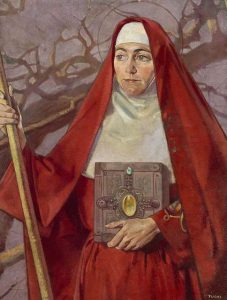
Saint Brigid of Kildare or Saint Brigid of Ireland (c. 451 – 525) is the patroness saint (or ‘mother saint’) of Ireland, and one of its three national saints along with Patrick and Columba.
According to mediaeval Irish hagiographies, she was an abbess who founded the important abbey of Kildare as well as several other convents of nuns.
Brigid is said to have been the daughter of a chieftain and a slave woman, and raised in a druid‘s household before becoming a consecrated virgin.
She is patroness of many things, including poetry, learning, healing, protection, blacksmithing, livestock and dairy production. In her honour, a perpetual fire was kept burning at Kildare for centuries.
Her feast day is 1st February, and traditionally it involves weaving Brigid’s crosses and many other folk customs.
There is debate over whether Brigid was a real person. There are few historical facts about her, and early hagiographies “are mainly anecdotes and miracle stories, some of which are deeply rooted in Irish pagan folklore”. She has the same name and many of the same attributes as the Celtic goddess Brigid, and there are many supernatural events and folk customs associated with her.
Like the saint, the goddess in Irish myth is associated with poetry, healing, protection, smithcraft, and domestic animals.
Brigid’s year of birth is usually given as 451 or 452 AD. One tradition is that Brigid was born at Faughart (just north of Dundalk), in Conaille Muirtheimne, part of the Kingdom of Ulaid. Another tradition is that she was born at Ummeras, near Kildare.
All early sources say she was one of the Fothairt, a people mainly based in Leinster.
Three biographies name her mother as Broicsech, a slave who had been baptised by Saint Patrick. They name her father as Dubhthach, a chieftain of Leinster.
The Vitae says that Dubhthach’s wife forced him to sell Brigid’s mother to a druid when she became pregnant. This might have been inspired by the Biblical story of Abraham and Hagar. It says that Broicsech gave birth to Brigid at dawn, on the threshold, while bringing milk into the druid’s house.
Brigid was thus born into slavery. Legends of her early holiness include her vomiting when the druid tried to feed her, due to his impurity; a white cow with red ears arrives to sustain her instead.
Brigid’s druid stepfather is portrayed somewhat sympathetically in the stories. He can see that Brigid is special, he is concerned for Brigid’s welfare, and he eventually frees her and her mother.
Brigid is said to have spent her youth as a farm worker; churning butter, shepherding the flocks and tending the harvest.
As she grew older, Brigid was said to have worked miracles, including healing and feeding the poor. According to one tale, as a child she once gave away her mother’s entire store of butter. The butter was then replenished in answer to Brigid’s prayers.
Around the age of ten, she was returned as a household servant to her father, where her charity is said to have led her to donate his belongings to anyone who asked.
In both of the earliest biographies, Dubhthach is so annoyed with Brigid that he took her in a chariot to the King of Leinster to sell her. While Dubhthach was talking to the king, Brigid gave away her father’s bejewelled sword to a beggar to barter it for food to feed his family. The king recognised her holiness and convinced Dubhthach to grant his daughter freedom.
According to tradition, around 480 Brigid founded a monastery at Kildare.
Brigid is also credited with founding a school of art, including metalwork and illumination. The Kildare scriptorium made the Book of Kildare, which drew high praise but disappeared during the Reformation. According to Giraldus, nothing that he ever saw was at all comparable to the book, every page of which was gorgeously illuminated, and the interlaced work and the harmony of the colours left the impression that “all this is the work of angelic, and not human skill”.
Brigid is said to have been given the last rites by Saint Ninnidh of the Pure Hand when she was dying. Afterwards, he reportedly had his right hand encased in metal so that it would never be defiled, and this was the origin of his epithet. Tradition says she died at Kildare on 1st February. Her year of death is usually placed around 524 or 525.
Upon Brigid’s death, Darlugdach became the second abbess of Kildare. Darlugdach was so devoted to her mentor that when Brigid lay dying Darlugdach expressed the wish to die with her, but Brigid replied that Darlugdach would die on the first anniversary of her (Brigid’s) death.
Collect for Brigid of Kildare
Grant that we, inspired by her example, may radiate your love in all we do, be instruments of your healing grace, and work for justice and compassion in the world.
Through Jesus Christ our Lord, who lives and reigns with you in the unity of the Holy Spirit, one God, forever and ever. Amen.
With thanks to Wikipedia and Google Gemini
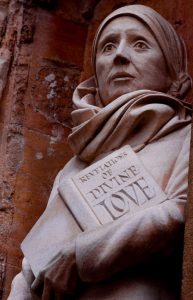 Julian of Norwich
Julian of Norwich (c. 1343 – after 1416), also known as Juliana of Norwich, the Lady Julian, Dame Julian or Mother Julian, was an English anchoress of the Middle Ages. Her writings, now known as Revelations of Divine Love, are the earliest surviving English language works by a woman, although it is possible that some anonymous works may have had female authors. They are also the only surviving English language works by an anchoress.
Julian lived in the English city of Norwich, an important centre for commerce that also had a vibrant religious life. During her lifetime, the city suffered the devastating effects of the Black Death of 1348–1350, the Peasants’ Revolt (which affected large parts of England in 1381), and the suppression of the Lollards.
In 1373, aged 30 and so seriously ill that she thought that she was on her deathbed, Julian received a series of visions or shewings of the Passion of Christ. She recovered from her illness and wrote two versions of her experiences, the earlier one being completed soon after her recovery. A much longer version, today known as the Long Text, was written many years later.
Julian lived in permanent seclusion as an anchoress in her cell, which was attached to St Julian’s Church, Norwich.
Four wills are known in which sums were bequeathed to a Norwich anchoress named Julian, and an account by the celebrated mystic Margery Kempe exists which provides evidence of counsel that Kempe was given by the anchoress.
Details of Julian’s family, education, or of her life before becoming an anchoress are not known; it is unclear whether her actual name was Julian. Preferring to write anonymously, and seeking isolation from the world, she was nevertheless influential in her lifetime.
While her writings were carefully preserved, the Reformation prevented their publication in print. The Long Text was first published in 1670 by the Benedictine monk Serenus de Cressy, reissued by George Hargreaves Parker in 1843, and published in a modernised version in 1864. Julian’s writings emerged from obscurity in 1901 when a manuscript in the British Museum was transcribed and published with notes by Grace Warrack; many translations have been made since. Julian is today considered to be an important Christian mystic and theologian.
Little of Julian’s life is known. The few scant comments she provided about herself are contained in her writings, later published in a book commonly known as Revelations of Divine Love, a title first used in 1670.
The earliest surviving copy of a manuscript of Julian’s, made by a scribe in the 1470s, acknowledges her as the author of the work.
The earliest known references to Julian come from four wills, in which she is described as being an anchoress. The wills were all made by individuals who lived in Norwich. Roger Reed, the rector of St Michael Coslany, Norwich, whose will of 20th March 1394 provides the earliest record of Julian’s existence, made a bequest of 12 shillings to be paid to “Julian anakorite”. Thomas Edmund, a Chantry priest from Aylsham, stipulated in his will of 19th May 1404 that 12 pennies be given to “Julian, anchoress of the church of St Julian, Conisford” and 8 pennies to “Sarah, living with her”. John Plumpton from Norwich gave 40 pennies to “the anchoress in the church of St Julian’s, Conisford, and a shilling each to her maid and her former maid Alice” in his will dated 24th November 1415. The fourth person to mention Julian was Isabelle, Countess of Suffolk (the second wife of William de Ufford, 2nd Earl of Suffolk), who made a bequest of 20 shillings to “Julian reclus a Norwich” in her will dated 26th September 1416. As a bequest to an unnamed anchorite at St Julian’s was made in 1429, there is a possibility that Julian was alive at this time.
Julian wrote in Revelations of Divine Love that she became seriously ill at the age of 30. On 8th May 1373 a curate administered the last rites of the Church to her, in anticipation of her death. As he held a crucifix above the foot of her bed, she began to lose her sight and feel physically numb, but gazing on the crucifix she saw the figure of Jesus begin to bleed. Over the next several hours, she had a series of 15 visions of Jesus, and a 16th the following night.
Julian completely recovered from her illness on 13th May. There is general agreement that she wrote about her shewings shortly after she experienced them. Her original manuscript no longer exists, but a copy, now known as the Short Text, survived. Decades later, perhaps in the early 1390s, she began a theological exploration of the meaning of her visions, and produced writings now known as The Long Text. This second work seems to have gone through many revisions before it was finished, perhaps in the 1410s or 1420s.
Julian’s revelations seem to be the first important example of a vision by an Englishwoman for 200 years, in contrast with the Continent, where “a golden age of women’s mysticism” occurred during the 13th and 14th centuries.
Julian of Norwich is now recognised as one of England’s most important mystics.
Collect for Julian of Norwich
Loving God, source of all being,
You granted your servant Julian profound visions of your unfailing love. Through her, you remind us that all shall be well and that your love is everlasting.
Grant us, like Julian, to see the world through your eyes, to find hope in darkness, and trust in your enduring presence.
May we live in the peace that surpasses understanding,
through Jesus Christ our Lord. Amen.
With thanks to Wikipedia and Google Gemini