Rafqa of Lebanon
Rafqa Pietra Chobok (29th June 1832 – 23rd March 1914) was a Lebanese Maronite nun who was canonised by Pope John Paul II on 10th June 2001.
She is a patron of lost parents and the sick.
Rafka was born in Himlaya, in Matn District, the only child of Saber Mourad El Rayess and Rafqa Gemayel, and was baptised Boutrossieh (the Arabic feminine of Peter). Her mother died when she was seven years old. In 1843, her father experienced financial difficulties and sent her to work as a servant for four years in Damascus at the home of Assaad Al-Badawi. She returned home in 1847 to find that her father had remarried.
When Boutrossieh was 14 years old, her stepmother wanted her to marry her brother, while her maternal aunt wanted her to marry her son. Boutrossieh did not want to marry either man, and this caused much discord in her family. One day, while she was coming back from the fountain holding her jar, she overheard them arguing. She asked God to help her to deal with the problem. She then decided to become a nun and went straight to the Convent of Our Lady of Liberation at Bikfaya.
Boutrossieh’s father and stepmother tried to take her back home but she refused. They returned home dismayed, and from then on never saw her again.
In 1860, while still stationed in Ghazir, Rafqa’s superiors sent her on a temporary posting to Deir-el-Qamar, in Mount Lebanon – Shouf, where she helped the Jesuit mission.
In less than two months the Druze killed 7,771 people and destroyed 360 villages, 560 churches, 28 schools, and 42 convents. Sister Rafqa saved one child’s life by hiding him in the skirts of her habit as he was being chased by some soldiers. Rafqa was deeply affected by the massacres.
Following a year of postulancy, Rafqa received the habit of her congregation on the feast of St. Joseph, 19th March 1861. She took her first temporary religious vows exactly a year later at the age of thirty.
Sister Rafqa’s first assignment in the congregation was in charge of the kitchen service in the Jesuit school in Ghazir, where she spent seven years. She was placed in charge of the workers and had the task of giving them religious instruction in a spinning mill in Scerdanieh, where she remained for two months. In her free time she studied Arabic, calligraphy and mathematics.
Two years later, Sister Rafqa was sent to teach at Byblos, where she remained for one year before going to Ma’ad to establish a school there at the request of Antoun (Anthony) Issa, a prominent citizen.
In 1871, the “Mariamettes” religious institute merged with another to form the Order of the Sacred Hearts of Jesus and Mary. The Religious Sisters were given the option to join the new congregation, or a different one, or to resume lay status. Rafqa decided to become a cloistered nun rather than a teaching Sister, and, after praying in the Church of St. George, made the decision to join the Baladita Order, the monastic order now named the Lebanese Maronite Order of St. Anthony, founded in 1695, and told Antoun Issa of her decision. He offered to pay the requisite dowry.
That same night, Rafqa dreamed of three men. One with a white beard, one dressed like a soldier and the third was an old man. She recounted “One of the men said to me, ‘Become a nun in the Baladita Order‘. I woke up very happy… and went to Antoun Issa, bursting with joy… and I told him about my dream.” Antoun identified the men as Anthony of Qozhaia (Anthony the Abbot) from whom the order was inspired, the soldier was Saint George, to whom the church in Ma’ad was dedicated, and the third could only be a Baladita monk. Rafqa decided to leave immediately for the Monastery of St. Simon in Al-Qarn. Antoun gave her the money as promised as well as a letter of recommendation to the archbishop.
At the age of thirty-nine, Rafqa began her novitiate into the new monastery and then on 25th August 1873 she “professed her perpetual vows of poverty, chastity and obedience in the spirit of the strict Rule of the Baladita Order”. She took on the new name that was her mother’s: Rafqa, (Rebecca), the name of Abraham‘s great-niece and wife of his son Isaac.
Gradually, Rafqa became blind. She experienced intense pain in her head, but considered this an opportunity to share in Jesus’ Passion. Rafqa did not let this pain isolate her from the community. She continued to spin wool and cotton, and knitted stockings for the other sisters; she also participated in choral prayer.
By 1899 she was completely blind and paralysed. She was confined to bed and used her time to knit socks.
Near the end of her life, she was asked by Sister Ursula if she would like to see; Rafqa prayed to be able to see for an hour, and this prayer was answered.
On 23rd March 1914, four minutes after receiving the Last Rites and the plenary indulgence, she died. Her body was buried in the monastery cemetery and was later transferred to the monastery chapel.
Collect for Saint Rafqa
Almighty God, who granted Saint Rafqa the grace to bear her sufferings with joy and unite herself to your Son on the cross, grant us through her intercession the strength to accept our own trials with faith and hope.
May her love for you and service to others inspire us to live as true disciples.
We ask this through Christ our Lord. Amen.
With thanks to Wikipedia and Google Gemini
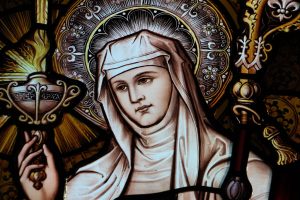 Clare of Assisi
Chiara Offreduccio (16th July 1194 – 11th August 1253), known as Clare of Assisi (sometimes spelled Clara, Clair or Claire), was an Italian saint who was one of the first followers of Francis of Assisi.
Inspired by the teachings of St. Francis, she founded the Order of Poor Ladies, a monastic religious order for women in the Franciscan tradition. The Order of Poor Ladies was different from any other order or convent because it followed a rule of strict poverty. Clare wrote their Rule of Life, the first set of monastic guidelines known to have been written by a woman.
Following her death, the order she founded was renamed in her honour as the Order of Saint Clare, commonly referred to today as the Poor Clares.
Clare was born in Assisi to the Offreduccio household during the High Middle Ages, the eldest daughter of Favarone or Favorino Sciffi, Count of Sasso-Rosso, and his wife Ortolana. Traditional accounts say that Clare’s father was a wealthy representative of an ancient Roman family, who owned a large palace in Assisi and a castle on the slope of Mount Subasio. Ortolana was a very devout woman who had undertaken pilgrimages to Rome, Santiago de Compostela and the Holy Land. Later in life, Ortolana entered Clare’s monastery, as did Clare’s sisters, Beatrix and Catarina (who took the name Agnes and was later declared a saint herself).
As children, Clare and her sisters were taught the ways of Christianity by their mother; they all became very religious and devoted to prayer. When Clare was 12 years old, her parents wanted her to marry a wealthy young man; however, she protested and said that she did not want to marry until she turned 18. As a teen, she heard Francis preach during a Lenten service in the church of San Giorgio at Assisi.
Inspired by his words and knowing that marriage was rapidly approaching, Clare went to Francis and asked him to help her to live after the manner of the Gospel. On the evening of Palm Sunday, 20th March 1212, with the consent of the Bishop of Assisi, Clare left her father’s house accompanied by her aunt Bianca and another companion and proceeded to the chapel of the Porziuncula to meet Francis. There, her hair was cut, and she exchanged her rich gown for a plain robe and veil. Fully cutting a woman’s hair was a symbolic act showing that she was no longer bound by the laws of man or society but rather that she followed the will of God.
Francis placed Clare in the convent of the Benedictine nuns of San Paulo, near Bastia.
Her family tried to induce her to return home, and when they eventually tried to use force she clung to the altar of the church and threw aside her veil to show her cropped hair. It was only after seeing her hair that her family relented and left her in peace.
Unlike the Franciscan friars, whose members moved around the country to preach, Clare’s sisters lived in enclosure, since an itinerant life was hardly conceivable at the time for women.
Their life consisted of manual labour and prayer. The nuns went barefoot, slept on the ground, ate no meat and observed almost complete silence. This was in accordance with the strict teachings of poverty assigned to Clare by Francis. Francis and Clare believed that through poverty they could become closer to Jesus as they would live the way he did. They were not inconvenienced by this lifestyle, but rather they believed it was a blessing, as they were following in the footsteps of Jesus Christ.
In 1216 Clare reluctantly accepted the role of abbess of San Damiano, giving her more authority to lead the order. She was very shy and did not like giving orders. On the rare occasions when she did, she would do so with great humility and shyness.
Clare would purposefully save the most tedious tasks for herself because she always wished to take care of her sisters.
During a visit to San Damiano, Pope Gregory IX urged Clare to give up her way of strict poverty, stating that “if you fear because of your vow, We dispense you from it”, to which she immediately responded, “Holy Father, never and in no way do I wish to be dispensed from following Christ!”
In her later years, Clare endured a long period of poor health. She died on 11th August 1253 at the age of 59, one day after having her Rule approved by Pope Innocent IV. Her last words are reported to have been, “Blessed be You, O God, for having created me.”
At her funeral, the Pope insisted that the friars perform the Office for the Virgin Saints as opposed to the Office for the Dead. This move ensured that the canonisation process for Clare would begin shortly after her funeral.
While the whole process took two years, the examination of Clare’s miracles took just six days. On 26th September 1255 Pope Alexander IV canonised Clare as Saint Clare of Assisi.
Collect for Clare of Assisi
O God, who didst inflame the heart of Saint Clare with a love of poverty and a desire to follow in the footsteps of your Son, grant that we, inspired by her example, may learn to detach ourselves from earthly possessions and seek You above all else.
May her intercession help us to live with simplicity and generosity, and to find true joy in serving You and our neighbour.
Through Jesus Christ our Lord. Amen.
With thanks to Wikipedia and Google Gemini