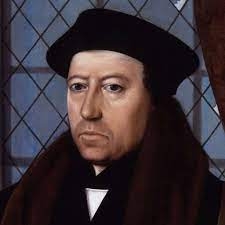
 Thomas Cranmer
Cranmer was at the forefront of the English Reformation, Archbishop of Canterbury and a founding figure in Henry VIII’s Protestant Church of England. The legacy of his words still shapes lives today – he wrote much of the Book of Common Prayer, and the statement known as the Thirty-nine articles.
His father had only enough property to endow one son, which meant that Thomas was destined for the church.
Cranmer called his teacher a “marvellous severe and cruel schoolmaster”.
He went to Jesus College, Cambridge, but had to leave because he married a relative of the landlady of the Dolphin Inn.
Cranmer was allowed back in to college when his wife died in childbirth!
He left Cambridge to escape the sweating sickness and went to lodge at a house in Waltham in Essex. Henry VIII was visiting in the immediate neighbourhood at the time and they met soon afterwards.
In 1530 Cranmer met the pope in Rome, and was appointed grand penitentiary of England.
He was involved in the ending of three of Henry’s marriages: to Anne Boleyn, Anne of Cleves, and Catherine Howard.
Queen Mary I, a Roman Catholic, had Cranmer tried for heresy and treason. He was forced to denounce his Protestant beliefs and swear allegiance to the Pope, but he still faced the death penalty.
Just before he was burned at the stake Cranmer revoked his statements and declared the Pope to be the antichrist. He thrust his hand into the fire first as a sign of remorse for his confessional writings.
Not many people can say that William Wordsworth wrote a sonnet about them:
‘Outstretching flame-ward his upbraided hand
(O God of mercy, may no earthly seat
Of judgement such presumptuous doom repeat!)
Amid the shuddering throng doth Cranmer stand’.
Cranmer quotes
“There was never any thing by the wit of man so well devised, or so surely established, which in continuance of time hath not been corrupted.”
Preface to the BCP
“For truly some there are that be too slow and need the spur, some other seem too quick, and need more of the bridle; some lose their game by short shooting, some by overshooting; some walk too much on the left hand, some too much on the right. In the former sort be all they that refuse to read or to hear read the scripture in the vulgar tongue; much worse, they that also let or discourage the other from the reading or hearing thereof. In the latter sort be they which by their indiscrete speaking, contentious disputing, or otherwise by their licentious living, slander and hinder the word of God most of all.”
Preface to the Great Bible
“In the midst of life we are in death.”
“I commend thy soul to God, and thy body to the ground, earth to earth, ashes to ashes, dust to dust, in sure and certain hope of the Resurrection.”
Order for Burial of the Dead, The Book of Common Prayer
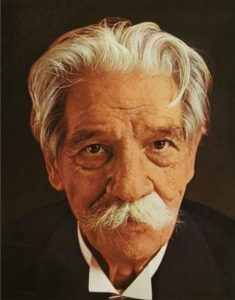 Albert Schweitzer
Schweitzer was born in Alsace at a time when it was a part of Germany, but became a citizen of France after World War I.
He grew up in an environment of religious tolerance: the parish church of Gunsbach was shared by the Protestant and Catholic congregations, which held their prayers in different areas at different times on Sundays. (This compromise began after the Reformation and the Thirty Years’ War.)
Schweitzer served his one-year compulsory military service in 1894.
On departure for Lambaréné in 1913, he was presented with a pedal piano, a piano with pedal attachments to operate like an organ pedal-keyboard. Built especially for the tropics, it was delivered by river in a huge dug-out canoe to Lambaréné, packed in a zinc-lined case.
He was one of the founders of The Committee for a Sane Nuclear Policy.
Recordings of Schweitzer playing the music of Bach are available on CD.
Schweitzer quotes
“Success is not the key to happiness. Happiness is the key to success. If you love what you are doing, you will be successful.”
“Example is not the main thing in influencing others. It is the only thing.”
“Constant kindness can accomplish much. As the sun makes ice melt, kindness causes misunderstanding, mistrust, and hostility to evaporate.”
“Learn from yesterday, live for today, hope for tomorrow. The important thing is not to stop questioning.”
“Do something wonderful, people may imitate it.”
“Man has lost the capacity to foresee and to forestall. He will end by destroying the earth.”
And just to prove that he wasn’t always brilliant: “There are two means of refuge from the miseries of life: music and cats.”