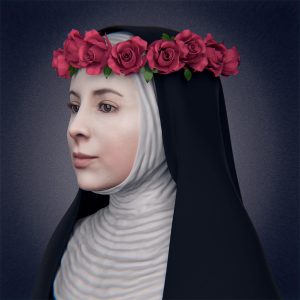
 Rose of Lima
Rose is the patron saint of embroidery, gardening and cultivation of blooming flowers.
She is the first person born in the Americas to be raised to sainthood.
Rose is also a co-patroness of the Philippines along with Pudentiana, patroness of the Americas, of the indigenous people of the Americas, and of Peru, especially the city of Lima, Sittard in the Netherlands, and of the Indies.
She was beatified by Pope Clement IX on 10th May 1667, and canonised on 12th April 1671, by Pope Clement X.
There were stories that she had cured a leper, and that, at the time of her death, the city of Lima smelled like roses; roses also started falling from the sky. Bad news for the local florists.
Many places in the New World are named Santa Rosa after her.
There is a park named for her in Sacramento, California.
In Trinidad and Tobago, the Santa Rosa Carib Community, located in Arima, is the largest organisation of indigenous peoples on the island.
Saint Lucia holds a flower festival for Rose on 30th August.
Rose’s skull, surmounted with a crown of roses, is on public display at the Basilica in Lima, Peru.
It was customary to keep the torso in the basilica and pass the head around the country.
The barony of Saint Rose of Lima was created in the Royal House of Rwanda on 25th July 2016.
Rose quotes
“Apart from the cross, there is no other ladder by which we may get to heaven.”
“When we serve the poor and the sick we serve Jesus. We must not fail to help our neighbours, because in them we serve Jesus.”
“Without the struggle of afflictions, it is impossible to reach the height of grace. The gift of grace increases as the struggle increases.”
“If only mortals would learn how great it is to possess divine grace, how beautiful, how noble, how precious. How many riches it hides within itself, how many joys and delights! No one would complain about his cross or about troubles that may happen to him, if he would come to know the scales on which they are weighed when they are distributed to men.”
 Polycarp
Polycarp is said to have been a disciple of John the Apostle and ordained by John as a bishop of Smyrna.
Some scholars attribute the pastoral epistles — the biblical books 1 Timothy, 2 Timothy, and the Epistle to Titus — to Polycarp rather than St Paul.
Polycarp definitely wrote his own letter to the Philippians.
He followed the Eastern practice of celebrating Easter on the 14th of Nisan, the day of the Jewish Passover, regardless of the day of the week on which it fell.
Relics of Polycarp are under the main altar of the church of Sant’Ambrogio della Massima.
The right arm had been kept at the Monastery of the Dormition of the Theotokos-Saint Polycarp, in Ampelakiotissa near Nafpaktos, Greece, for over 500 years. It was stolen on 14th March 2013 and never recovered; however, a fragment, taken from the arm on a previous occasion, was discovered and returned to the monastery on 14th July 2019.
Polycarp quotes
On the day of his death: “Eighty and six years I have served Him, and He has done me no wrong.”
“You threaten me with a fire that burns for a season, and after a little while is quenched; but you are ignorant of the fire of everlasting punishment that is prepared for the wicked.”
“I bless you, Father, for judging me worthy of this hour, so that in the company of the martyrs I may share the cup of Christ.”