Barbara
Venerated as one of the 14 Auxiliary Saints (Holy Helpers), Barbara is invoked in thunderstorms and is the patron saint of armourers, artillerymen, architects, mathematicians and miners.
Some accounts name the ancient Egyptian city of Heliopolis, others Nicomedia or a town in Tuscany, as the scene of her sufferings.
She was baptised by a priest from Alexandria, disguised as a merchant.
When her father had a luxurious bathhouse built, Barbara traced a cross with her finger on one of the walls. The cross was deeply etched into the marble, as if by an iron instrument. Later, her footprints were imprinted on the stone steps of the bathhouse.
Barbara’s relics rest at the Cathedral of St Vladimir in Kyiv.
Spanish, Italian and French seamen placed the storage room that held munitions on their boats under the protection of St Barbara. In those navies the munitions room is called santabárbara (Spanish), Santa Barbara (Italian) and Sainte-Barbe (French)
The name “barbiturates” is derived from St. Barbara. In 1864, German chemist Adolf von Baeyer wanted to coin a name for a compound he had discovered. An artilleryman whom he met celebrating the feast of Saint Barbara recommended the saint’s name. Von Baeyer agreed and called the chemical barbituric acid — the parent compound of barbiturates from which barbiturates are derived.
The Lebanese have a custom to make St. Barbara biscuits in the shape of cannonballs.
Barbara quotes
‘She is risen for all the humble, she has heard the conquered calling, St. Barbara of the Gunners, with her hand upon the gun.’ The Ballad of St. Barbara, G.K. Chesterton
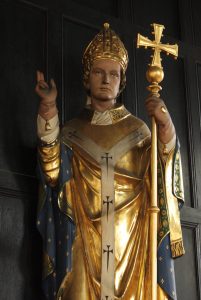 Cyprian
He is the patron saint of Algeria and of North Africa.
Cyprian practiced as a lawyer in Carthage before he was converted to Christianity in about 246.
His first Christian writing is a monologue spoken to a friend, sitting under a vine-clad pergola.
Seven councils of African bishops in Carthage were called by Cyprian in his ten years as Bishop.
Cyprian endorsed the idea that only sacraments administered by a “legitimate” bishop held the power of salvation.
He disagreed with the Bishop of Rome (Stephen I) in believing that all bishops are equal and that there should be no one single leader (ie, a pope).
He ordered 25 gold pieces to be given to his executioner.
Cyprian quotes
“Custom is often only the antiquity of error.”
“The word of God was led, wordless, to the cross.”
“A second birth created me a new man by means of the Spirit breathed from heaven.”
“I am a Christian and cannot sacrifice to the gods. I heartily thank Almighty God who is pleased to set me free from the chains of this body.”