Rita
Rita
Rita is the patron saint of sterility, abuse victims, loneliness, marriage difficulties, parenthood, widows, the sick, bodily ills, and wounds.
On the day after her baptism, her family noticed a swarm of white bees flying around her as she slept in her crib. Rather than hurting her the bees peacefully entered and exited her mouth without causing her any harm or injury.
In 1961 French painter Yves Klein created a Shrine of St. Rita, which is in Cascia Convent.
Rita was meditating when a small wound appeared on her forehead, as though from a thorn from the crown that encircled Christ’s head.
At the time of her death, the sisters of the convent noticed that her forehead wound remained the same, with drops of blood still reflecting light. When her body was later exhumed, her forehead wound was still there. Over several years, her body was exhumed twice more and each time her body appeared the same.
St. Rita is often depicted holding roses or with roses nearby.
Rita quotes
“Let me, my Jesus, share in Thy suffering, at least one of Thy thorns.”
“Most Holy Sacred Heart of Jesus, help my heart to persevere in all that is holy.”
Buy St Rita

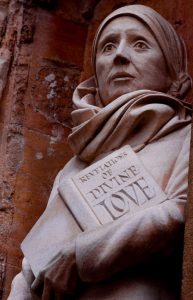 Julian of Norwich
Her “Revelations of Divine Love” is the first known book written by a woman in English.
Virtually nothing is left of the original cell where Julian lived. In the 1950s the cell was reconstructed, along with the church which had been destroyed during WWII bombardment.
The complete lack of biographical information on Julian has encouraged later scholars to construct their own biographies for her based on ‘clues’ that they seize upon in the book which are then linked to knowledge of life in the Middle Ages.
These life stories variously depict Julian as a widow who lost her family to the plague and renounced the world; a scholar who turned her back on society; and a layperson who only became an anchoress after her visions, among other possibilities. In reality, all that is known is what she mentions in her work: she lived in Norwich as an anchoress; experienced a near-fatal illness; had a mother who tended her while sick; and was served by a maid.
As an anchoress, she was not to send or receive letters. No animal was to be kept except a cat, which could go out and in unattended. She was warned against the easy temptation of becoming the town gossip. Many people would come to her window to seek counsel. She could not betray these confidences.
Julian quotes
“In my folly, before this time I often wondered why, by the great foreseeing wisdom of God, the onset of sin was not prevented: for then, I thought, all should have been well. This impulse [of thought] was much to be avoided, but nevertheless I mourned and sorrowed because of it, without reason and discretion.
“But Jesus, who in this vision informed me of all that is needed by me, answered with these words and said: ‘It was necessary that there should be sin; but all shall be well, and all shall be well, and all manner of thing shall be well.’
“These words were said most tenderly, showing no manner of blame to me nor to any who shall be saved.”
“God loved us before he made us; and his love has never diminished and never shall.”
Buy Julian